
How to Increase and Accelerate Literacy
How to Increase and Accelerate Literacy
Best Practices Techniques for the Science of Reading
Susan Kahn’s first-grade son did not learn to read in 1977. How did she react to this school failure? She became an Orton-Gillingham language therapist and taught her son to read in 4 months. Yes, the Science of Reading method for phonics has been known but seldom used for almost 100 years. Few universities offer courses in How To Teach phonics, morphology, or grammar. As a result, almost 70% of 4th and 8th-graders do not read at grade level. However, good news for MA families just arrived: the MA Senate and House have unanimously passed literacy bills, and Governor Healey is offering 25 million dollars to train teachers in the Science of Reading instruction.
After Mrs. Kahn taught her dyslexic, ADD son to read, she returned to graduate school, took 33 advanced credits in special education, and changed her career from elementary school teacher to Special Needs educator. After fifty years of teaching special education students from age 6 to 60 in both public and private settings, what effective teaching methods will Mrs. Kahn share to improve literacy? Here they are!
- Simplify the language. For example, teachers often show students how to divide words into syllables by using the VCCV rule or the VCV rule. The similarity of letters confuses many students. Mrs. Kahn suggests practical names that suggest the action needed. The SHARE strategy informs the student to share consonants standing between 2 vowel sounds. Just this change of name enables students to read words like supper, monster, and diphthong. The 3/4 or DONUT strategy replaces the VCV rule by teaching children how to divide words when only one consonant stands between 2 vowel sounds. Three times out of four, the vowel sound should end the syllable, and the extra consonant should move to the next syllable on the right: do nut, po ta to, and sai lor.
- Use three or more memory tactics to teach each skill. Researchers agree that most students remember better and longer when facts are augmented by pictures, patterns, and stories. By using all three mnemonics, the teacher is supporting a variety of different learning styles and equalizing educational opportunities. If students also communicate accurately in speech and writing what they learned, two more memory tactics are added. Now the brain is learning to read from five different stimuli. No wonder reading progress accelerates!
- Show students an animated, instructional video for each skill. The video does not produce long-term memory because practice leads to mastery. However, the videos attract and maintain attention. They present the strategy in an appealing way. Teachers can use the videos to explain new skills and/or to review them.
For over fifty years, Ms. Kahn’s special education students have achieved 90% reading accuracy within one academic year. In addition, most of these students showed improvement in reading comprehension of two to three grade levels. If teachers were trained to simplify their language and provide several mnemonics for each skill, couldn’t 90% of our MA students read at grade level?
EXAMPLE OF TEACHING WITH MEMORY TACTICS
PURPOSE OF LESSON:
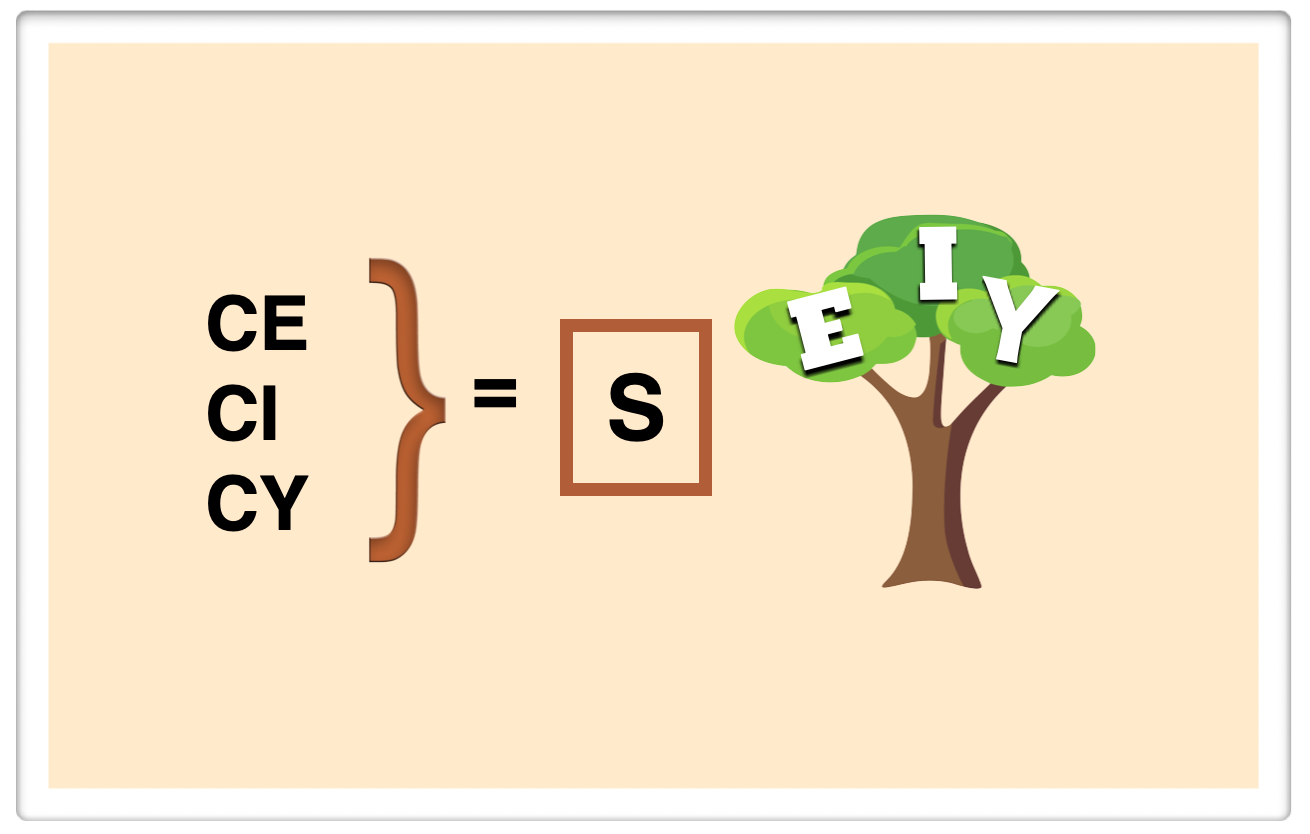
When does C make an S sound and when does C makes a K sound?
The Story memory tactic:
Ms. Kahn created the smart tree story. Since ordinary trees grow only one fruit, the SUPER-SMART C tree grows 3 letters: E, I, Y. If C precedes E or I or Y, C makes an S sound. All other C’s make a K sound. While some students cannot remember such facts without a story, bright children make up their own stories for this phonetic fact and share their stories with classmates.
The pattern memory tactic combines with an illustration of the Super-Smart C Tree. Picture a huge capital letter Y as a tree with two branches. On one branch grow E’s; on the other branch, I’s. The trunk of the tree grows Y’s. Next, say: C before E, C before I, C before Y make the S sound like center, circle, and cycle. Other C’s make the K sound like cap, cop, cup, clap, crop. Also, ask students to stand and extend their arms up high like the branches of a tree. Then the children should trace in the air the E, I, and Y. They should also communicate the C strategies.
Did Ms. Kahn say three memory tactics? Using the body adds a kinesthetic memory and speaking the rule enhances long-term memory. Mrs. Kahn just demonstrated five memory tactics. What about the corresponding, animated, instructional videos? Check out YouTube Sue’s Strategies Episode 1, “C Makes S & K Sounds,” and Episode 44, “C sounds like S or K.” By teaching C Makes 2 Sounds with six different memory strategies, learning accelerates.
Recent Posts

Reading
See the Bundle

Spelling
See the Bundle

Grammar
See the Bundle