
De-emphasize Sight Words
Sight words are not so important!
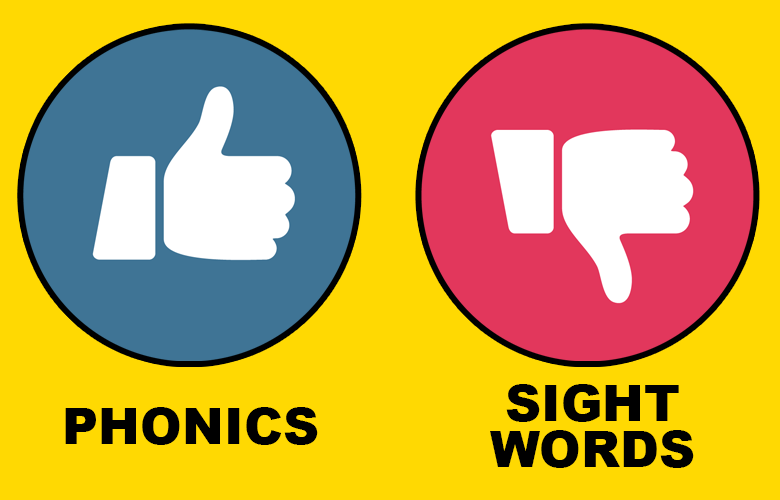
SIGHT WORDS ARE NOT SO IMPORTANT!
First and second grade teachers spend too much time emphasizing SIGHT WORDS!
Will SIGHT WORDS predict future reading success?
No. Children who struggle to memorize sight words often experience learning challenges with visual memory deficits for letters in the correct sequence. Perhaps, the sight word difficulty provides an excellent screening test for learning disabilities, but the sight words do not tell anything about a student’s ability to comprehend.
Will SIGHT WORDS expand a child’s ability to remember new, irregular sight words?
No! The underlying visual memory deficit remains, and the struggle to memorize unusual spellings does not lead to cognitive growth.
Will SIGHT WORDS discourage, irritate, depress, and turn off some new readers?
Yes! The memorization of sight words lacks a potent strategy to promote reading success. Also, the memorization process for children with learning challenges takes an excessively long amount of time and effort.
Are SIGHT WORDS as important to comprehension as phonetic strategies to unlock words?
No! The child who sounds out run, bat, catch, kick, and dodge can comprehend the sentence. The child who lacks phonetic decoding skills but knows is, were, could, and does cannot derive meaning from these words. Furthermore, children can use context clues to figure out many sight words. WHO and WHAT require teaching.
SIGHT WORDS ARE NOT SO IMPORTANT!
Are SIGHT WORDS considered important for middle and high school students?
No, SIGHT WORDS appear less frequently in advanced texts, and most students have learned them, one way or another, by middle school.
RECOMMENDATIONS
- Reduce the number of SIGHT WORDS in the first and second grade curriculums.
- Emphasize the phonetic decoding strategies that promote accurate, successful readers.
POSITIVE RESULTS
- Most children will phonetically decode words with 90% accuracy.
- Negative attitudes about reading will diminish.
- High School dropouts will decrease.
- Children will develop strategies to learn independently through instruction in decoding skills such as sound-to-symbol correspondence, recognizing the Orton-Gillingham six basic syllable types, and using syllabication rules as needed.
Recent Posts

Reading
See the Bundle
Spelling
See the Bundle
Grammar
See the Bundle